When most people walk along False Creek, they see the city — seawalls, marinas, and the hum of development. But a Langara College–led research partnership is revealing a hidden community of life below the surface, and students are at the heart of that work.
“The goal is to test the waters to see how providing a combination of scientific knowledge, connection to place, and opportunities for engagement changes a community’s relationship with False Creek,” says Kevin Rey, Science Literacy instructor at snəw̓eyəɬ leləm̓ and co‑principal investigator on the three‑year project “False Creek”: Community Connected by Water. The initiative pairs cutting‑edge environmental DNA (eDNA) methods with community stewardship and creative storytelling to map how biodiversity changes across seasons and years.
Partners and methods
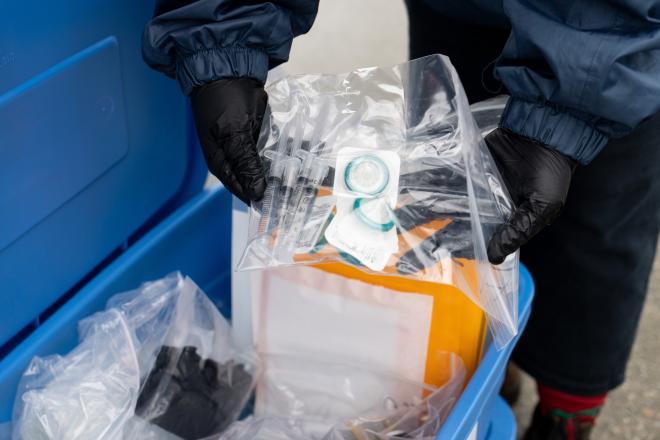
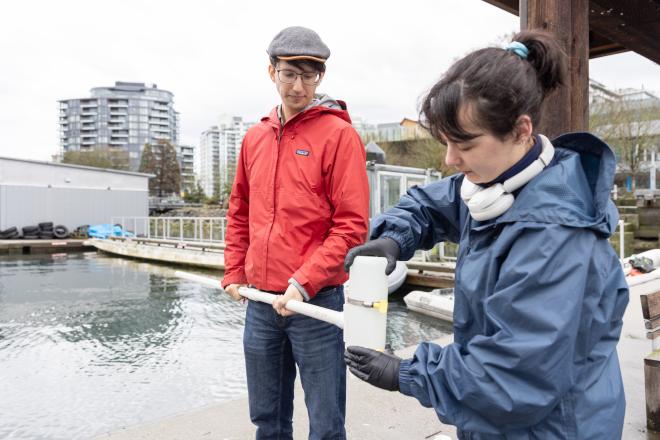
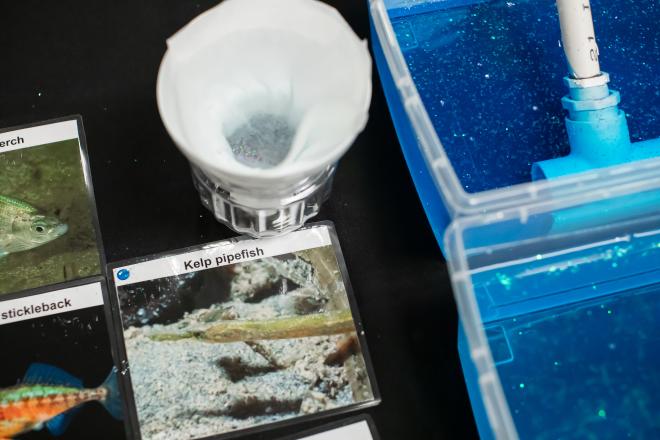
Langara’s Applied Research Centre (ARC) is one of several partners — alongside the False Creek Friends Society, Hakai Institute, and the Aloera Climate Creative Society — working with funding from the Natural Sciences and Engineering Research Council of Canada (NSERC) and the Canada Council for the Arts. Using eDNA, researchers and students collect water samples and detect genetic traces left behind by organisms, from microbes to fish, without needing to capture them. Earlier work in False Creek had already identified 21 fish species and more than 1,200 DNA sequences. The current phase will track how that biodiversity changes over time.
Students learning real research skills
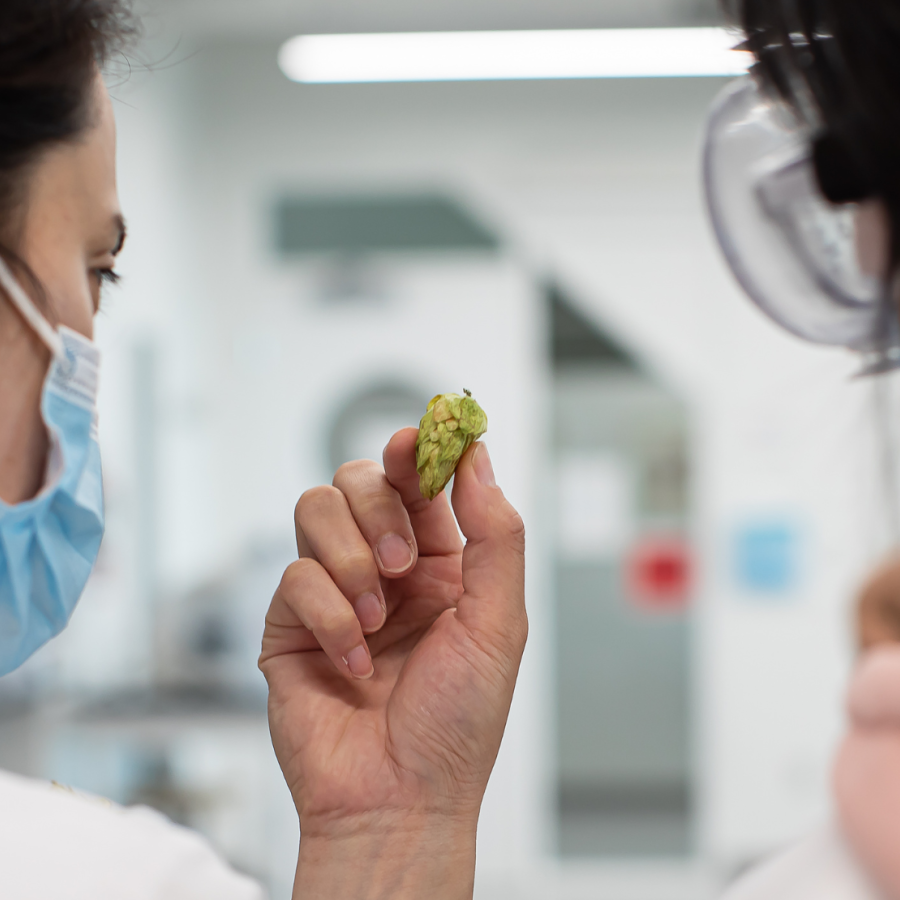
Students are not idle observers in this project; they are active researchers. “Langara students play important roles in the research,” Rey explains. “They will help with field surveys and environmental sampling, designing and delivering public education and communication material, processing samples in the lab for follow‑up DNA sequencing studies, and helping us analyze data.” For many students, that means learning sterile technique in the field, filtering and processing samples, and helping translate scientific findings into accessible public programming.
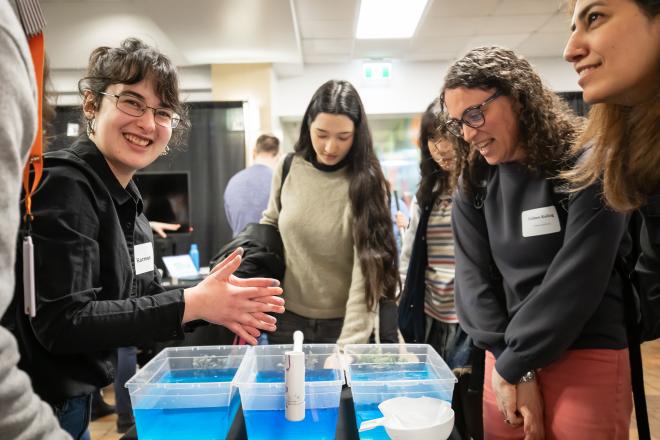
Karmen Legge is a second-year Environmental Studies student. As a student researcher on the project, she found the interdisciplinary scope a major draw. “I was excited to be doing sampling in the field, with the opportunity to also participate [in] science communication,” she says. Her primary role has been assisting with sampling and learning eDNA collection methods. She’s also helped prepare materials for public presentations and shared an educational and hands-on activity at Langara’s Applied Research Day on March 19.
Connecting classroom learning to careers
For students, the benefits extend beyond technical skills. “From an educational perspective, it gives students a chance to make connections between what they’ve seen in the classroom and how these concepts play out in real life,” says Kyra Janot, Biology instructor and co‑principal investigator. “They also have a chance to develop broadly useful skills in problem solving and critical thinking while supported and mentored.” Rey adds that early research experience helps students make informed career decisions: trying different types of work lets them discover what they love — and what they don’t — before graduation.
Conservation beyond pristine ideals
Karmen says the project changed how she views urban conservation. “One of the most valuable things I have learnt from this project is that conservation is not linear; just because an ecosystem can’t be restored to its ‘pristine’ state doesn’t mean there are no ways of protecting the life that still persists.” That idea sits at the core of the project: stronger ecological knowledge paired with meaningful local stewardship.
A place to start meaningful research
At Langara, students can take part in applied research early in their studies, building experience, confidence, and career‑relevant connections along the way. Through the Applied Research Centre, they work with faculty researchers and external partners on projects that matter to communities in Vancouver and beyond.
Langara’s Applied Research Centre (ARC) brings together faculty, students and community partners on applied research projects with real-world impact. Students interested in getting involved can watch for research assistant postings on the C3 Job Board.
Earth day
April 22, 2026, highlights the global celebration of Earth Day, a moment that continues to unite people in support of environmental protection and peace. Learn more about Earth Day at Langara.
False Creek location photos by Perrin Grauer | Emily Carr University of Art + Design.