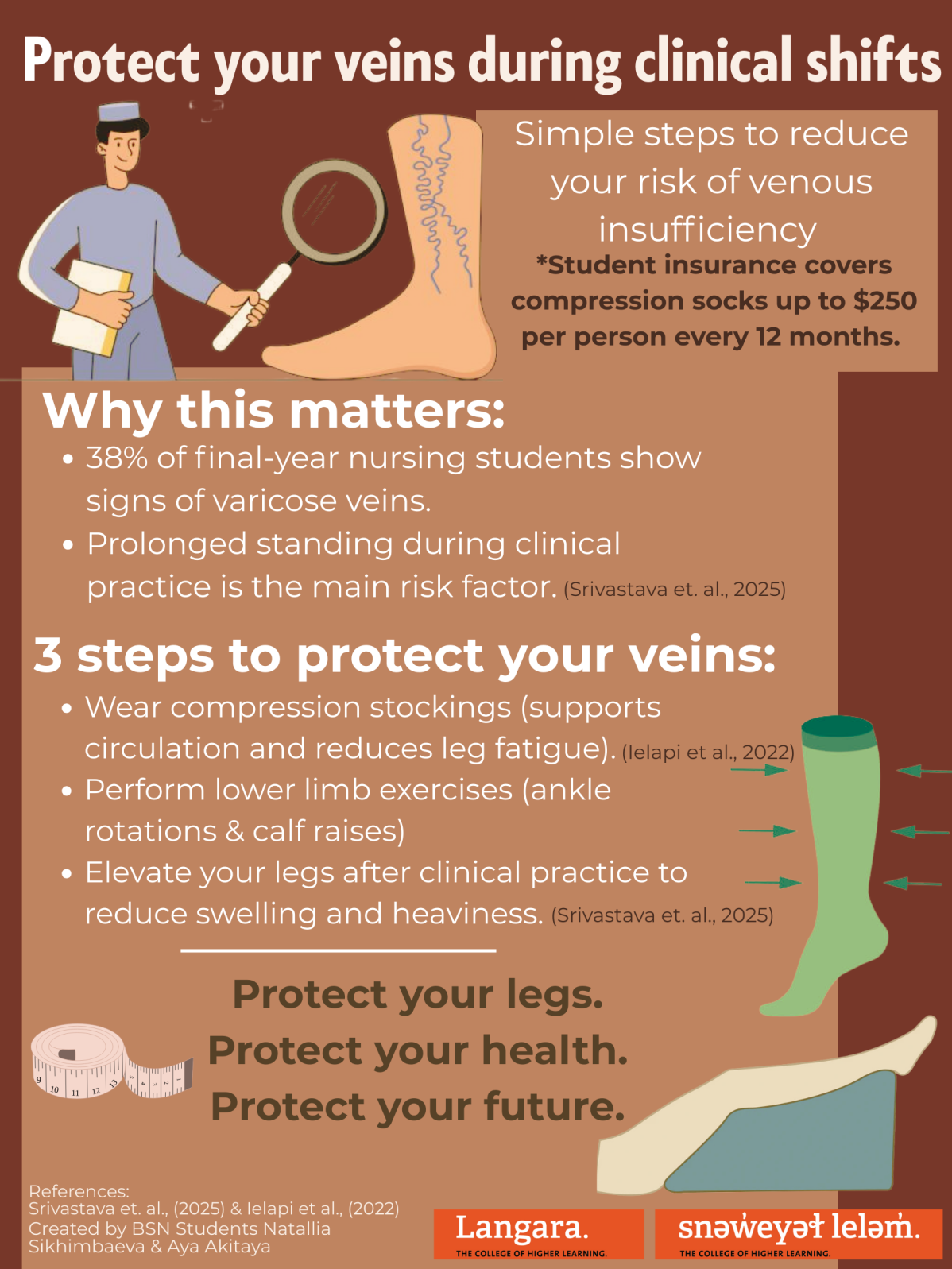
At Langara College, Nursing students aren’t just preparing to enter the profession, they’re already helping shape it. Through an applied research project focused on preventing lower leg venous insufficiency, students are addressing a real and often overlooked challenge in nursing: the physical toll of long shifts spent on their feet.
“Nurses and nursing students are required to stand for long periods of time, and some complain about vein-related symptoms such as swelling and pain,” says Denise Thomas, principal investigator and nurse educator at snəw̓eyəɬ leləm̓. “Compression stockings are effective for vein-related symptoms.”
Student-led research with real-life relevance
For Term 8 Nursing students Natallia Sikhimbaeva and Aya Akitaya, the issue felt immediate and personal.
“During my clinical days, I started noticing early signs of venous insufficiency in my own legs after long hours of standing,” Natallia says. “I realized that many other nursing students were experiencing the same thing but didn’t know what it meant for their future health or how to prevent it.”
Aya explains, “Lower leg venous insufficiency isn’t something we really talk about early in our nursing education. As students and new graduates, we are often young and healthy, so it doesn’t feel immediately relevant.”
Working alongside faculty and peers, Natallia and Aya led a literature review that uncovered a critical gap in existing research. “None of the studies focused on new graduate nurses or nursing students,” Natallia explains, pointing to the need for more prevention strategies for people entering nursing practices.
The team turned their findings into practical resources, including an infographic and simple prevention strategies for fellow students and new nurses.
Learning beyond the classroom
This project reflects Langara’s hands-on, evidence-based approach to nursing education. Students work closely with faculty and gain experience that extends far beyond lectures and labs. “It was my first experience planning a research project, and everyone was very supportive. I felt guided throughout the process,” Natallia says. For her, the experience opened a new side of nursing she hadn’t previously considered, one that combined patient care, prevention, and research-driven problem solving.
The research team also had the opportunity to collaborate across academic disciplines, working with a peer studying a vastly different field. They engaged recent Design Formation grad and current Student Research Aide Dani Loyola Molina to create visual communication materials, helping bring the research to life. “We really wanted to stop and let nurses know they are appreciated. We’re noticing these trends because we genuinely care,” he says.
A focus on wellbeing in nursing practice
The project also reinforces a key message for the future of healthcare: “Caring for the caregiver is paramount,” says Thomas, noting that nurse wellbeing is essential to safe and sustainable practice.
For Natallia, the experience reshaped her perspective. “This changed the way I think about nursing practice. Protecting our own health is just as important as caring for patients.”
Aya adds, “Lower leg venous insufficiency matters for nursing students and newly graduated nurses because prevention is key, especially before complications arise. By building awareness early on, students and new grads can develop good habits around prevention, such as recognizing early signs, encouraging movement, and supporting the use of compression stockings.”
By connecting students to meaningful research and real workplace challenges, Langara is preparing future nurses to enter the profession with skill, care, and curiosity; and to help improve it from the inside.
Explore Langara’s Nursing program and gain hands-on experience that goes beyond the classroom. From working closely with faculty to collaborating across disciplines, you’ll build the skills to make a meaningful impact in healthcare and your community.
About National Nursing Week
National Nursing Week draws attention to nurses, increasing the awareness of the public, policymakers, and governments of the many contributions of nursing to the well-being of Canadians. In 1971, the International Council of Nurses (ICN) designated May 12, the birthday of nursing pioneer Florence Nightingale, as International Nurses Day. In 1985, Canadian Nurses Association (CNA) members passed a resolution to begin negotiations with the federal government to have the week containing May 12 proclaimed as National Nurses Week annually. Soon after, the federal minister of health proclaimed the second week of May as National Nurses Week. In 1993, the name was changed to National Nursing Week to emphasize the profession's accomplishments as a discipline.