Advanced Medical Office Administrator (MOA)
About
The Advanced Medical Office Administrator (MOA) Certificate prepares students with the specialized knowledge, technical skills, and professional competencies required to work confidently in today's rapidly evolving healthcare environment.
Designed for adult learners, career changers, newcomers to Canada, and professionals seeking to transition into healthcare administration, this part-time program combines flexible online learning with practical, hands-on training that reflects the realities of modern medical offices.
Building on the Medical Office Assistant Foundations Certificate, students develop advanced skills in electronic medical records (EMRs), medical office workflows, healthcare communication, anatomy and physiology, cultural safety, equity, diversity and inclusion in healthcare, and emerging technologies shaping patient care.

Practicum
A distinctive feature of the program is its immersive simulated practicum experience, where students apply their knowledge in realistic healthcare scenarios using industry-relevant technologies and workflows. Rather than simply learning procedures, students develop the critical thinking, problem-solving, professionalism, and adaptability that today's employers value.
Educators
Courses are taught by experienced Medical Office Administrators, healthcare leaders, and educators who bring extensive frontline and management experience to the classroom. Their diverse backgrounds in medical clinics and healthcare organizations ensure students gain practical insights, current industry knowledge, and real-world perspectives that extend beyond textbooks.
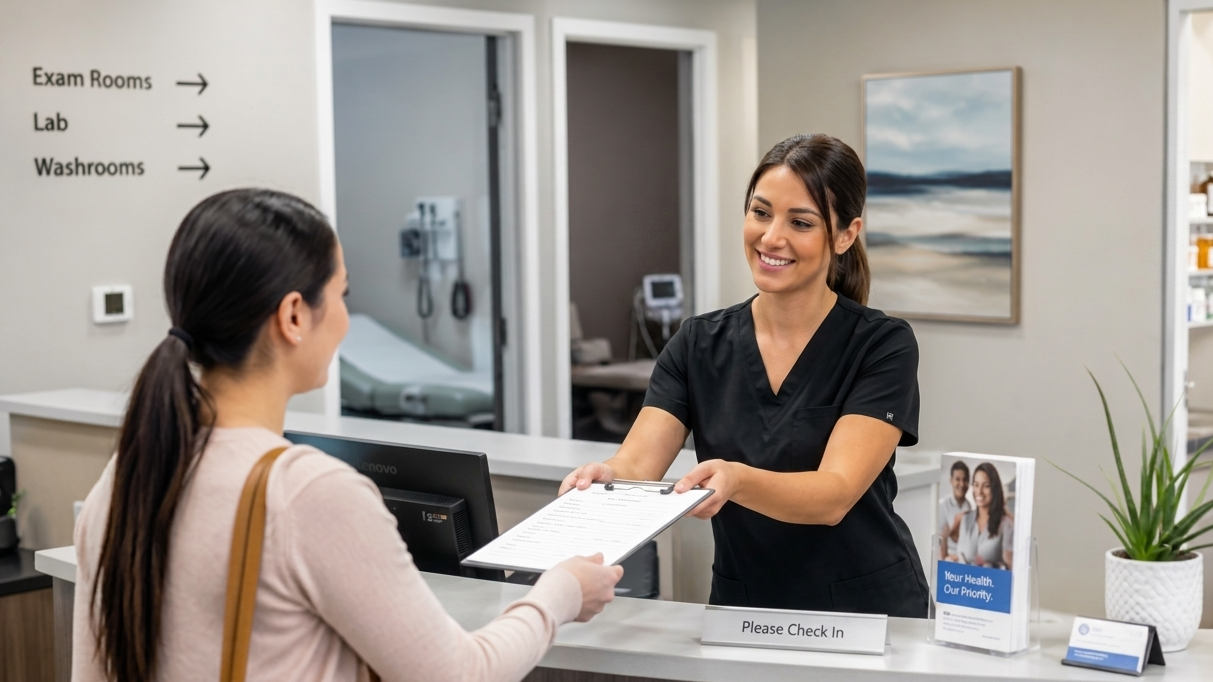
Whether you are entering the healthcare sector for the first time, returning to the workforce, or looking to advance your administrative career, the Advanced MOA Certificate provides a flexible pathway to develop in-demand healthcare administrative skills and prepare for a rewarding career supporting patients and healthcare teams.
Curriculum
The Advanced Medical Office Administrator (MOA) Certificate combines foundational medical office training with specialized healthcare education and applied practical experience. Students progress through a carefully designed curriculum that builds the knowledge, technical skills, and professional competencies required to thrive in today's healthcare environment.
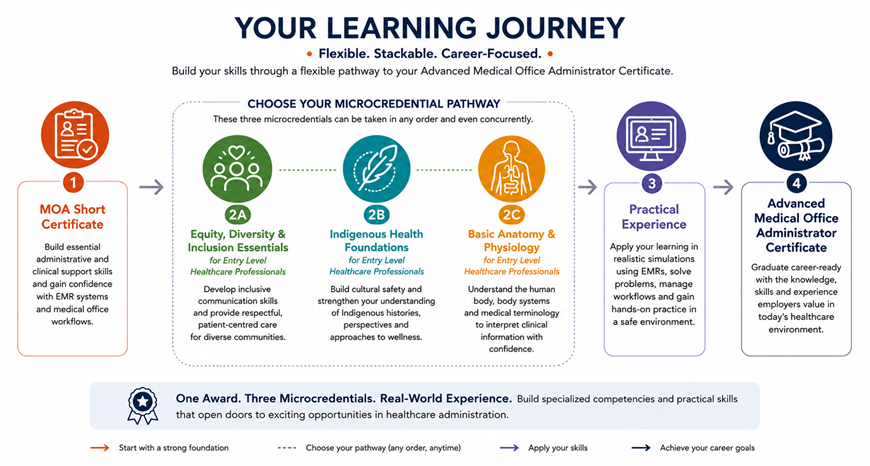
A stackable learning pathway designed for working professionals—earn one certificate, three industry-relevant micro credentials, and practical experience that prepares you for today's healthcare workplace.
Medical Office Assistant Short Certificate
The program begins with the Medical Office Assistant (MOA) Short Certificate, where students develop the essential administrative and clinical support skills required in modern medical offices.
Students learn to:
- Communicate professionally with patients and healthcare teams
- Manage appointments, referrals, and medical office workflows
- Apply medical terminology in everyday clinical practice
- Navigate Electronic Medical Records (EMRs)
- Perform medical billing and documentation
- Apply privacy, confidentiality, and ethical standards
- Support physicians and allied healthcare professionals through efficient administrative practices
This certificate establishes the practical foundation upon which the remainder of the Advanced MOA program is built.
Basic Anatomy and Physiology for Entry Level Healthcare Professionals
Healthcare administrators work alongside physicians and other healthcare professionals every day. This microcredential provides the scientific foundation needed to confidently understand clinical language and healthcare documentation.
Students explore:
- Medical terminology and anatomical language
- Human anatomy and physiological processes
- Major body systems and their functions
- Cells, tissues, skin, bones, and muscles
- Common diseases and disorders
- Clinical interpretation of anatomical diagrams and healthcare documentation
Graduates develop the confidence to communicate effectively within healthcare teams while better understanding referrals, diagnostic reports, and patient records.
Equity, Diversity and Inclusion Essentials for Entry Level Healthcare Professionals
Inclusive healthcare begins with understanding the diverse experiences of the patients we serve. This micro-credential prepares students to contribute to welcoming, respectful, and equitable healthcare environments.
Topics include:
- Equity, diversity, and inclusion principles in healthcare
- Cultural humility and self-reflection
- Inclusive communication strategies
- Patient-centered care
- Health disparities in British Columbia
- Legal and ethical considerations
- Professional development for inclusive healthcare practice
Students develop practical skills to support patients from diverse backgrounds while fostering respectful and collaborative healthcare workplaces.
Indigenous Health Foundations for Entry Level Healthcare Professionals
Understanding Indigenous histories, perspectives, and experiences is essential for providing culturally safe healthcare in British Columbia.
Students examine:
- First Nations, Inuit, and Métis histories and cultures
- The ongoing impacts of colonization and systemic racism
- Indigenous approaches to health and wellness
- Cultural safety and trauma-informed administrative practice
- Respectful communication with Indigenous patients and communities
- Indigenous rights and healthcare responsibilities
Through self-reflection and practical scenarios, students build the knowledge and awareness needed to support culturally safe, respectful, and inclusive healthcare experiences.
Practical Experience
The programme culminates in an immersive Practical Experience course, where students integrate the knowledge and skills acquired throughout the certificate in realistic healthcare scenarios.
Rather than observing workplace practices, students actively perform the role of a Medical Office Administrator through guided simulations that mirror the pace and complexity of today's healthcare settings.
Practical learning includes:
- Electronic Medical Record (EMR) workflows
- Patient registration and health information management
- Privacy, confidentiality, and cybersecurity
- Professional communication and conflict resolution
- Difficult patient interactions and de-escalation strategies
- Medical office operations and documentation
- Equity-informed administrative practice
- Navigation of the BC healthcare system
- Capstone simulations integrating administrative, technical, and interpersonal skills
By the end of the programme, graduates have developed the confidence, professionalism, and practical experience required to transition successfully into entry-level healthcare administrative roles.
