Langara College is reshaping sustainability education through its Environmental Studies course, ENVS 2100. The course follows a “living lab” model focusing on hands-on sustainability projects on campus. By using snəw̓eyəɬ leləm̓ as a working case study, students explore the United Nations Sustainable Development Goals (SDGs) while engaging with Langara's climate action commitments.
In previous years, ENVS 2100 partnered with CityStudio, facilitating student projects with the City of Vancouver. As the course evolved, ENVS 2100 shifted its focus back to campus-based projects. For the teaching team, this change opened new opportunities to ground learning directly in Langara’s own sustainability priorities. “We are excited about this transition,” says Mike Smith-Cairns, Chair of the Department of Interdisciplinary Studies and an instructor in Geography and Geology. “Curriculum-wise, it allows us to align our objectives more closely with Langara’s own sustainability framework.”
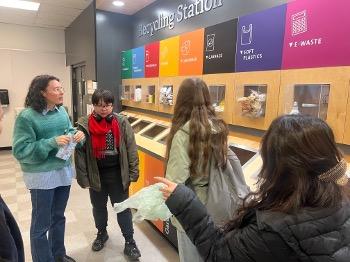
During the last semester, Smith-Cairns worked closely with Langara’s Facilities team, guiding students through a range of projects across the 12-week course. Students dove into real-world challenges such as wetland restoration, active transportation, waste reduction, and green space revitalization. These initiatives improve the campus while giving students practical experience that reinforces classroom learning. “We want to connect theoretical knowledge with practical application,” explains Smith-Cairns. “There’s no better way to understand sustainability than by directly engaging in these initiatives.”
The approach also fosters a close-knit learning environment where students benefit from smaller classes and regular contact with instructors. Conversations continue beyond lectures. Peer collaboration comes naturally. As Smith-Cairns emphasizes, “Our students appreciate the wraparound support they find at Langara. It’s more than just a place to learn; it’s where they start to form their career identities.”
Patricia Baker, Director of Energy and Sustainability, plays an important role in linking academic work with campus operations. Her involvement gives students insight into how sustainability initiatives function day to day.
She says, “Applied learning transforms sustainability from an abstract concept into something tangible, immediate, and empowering for our students. This hands-on approach highlights the many ways sustainability and climate action intersect with emerging career pathways, from data analysis and design to health, business, and community planning. It also sparks new ideas by bringing together students, faculty, staff, and operational teams in ways that break down silos and strengthen our shared commitment to the UN Sustainable Development Goals. When students see their work influence real decisions on campus, they gain the skills, confidence, and perspective needed to lead meaningful change far beyond Langara.”
Neringa Astrauskaite and Chelsea Q. recently completed the ENVS 2100 course. They both now hold key roles in the College’s Sustainability Leaders Program.
Neringa reflects, “The course helped me see how sustainability ideas can be turned into real actions on campus, not just discussed in theory. It encouraged me to think more deeply about environmental issues and to approach solutions by starting with small, manageable steps that can eventually lead to something bigger."
Chelsea echoes those sentiments, adding, “I was able to gain a better understanding about urban sustainability, and the role cities play in promoting environmental initiatives. While leading the Sustainability Leaders Program, I plan to apply these insights by educating and encouraging others to learn about different city environmental initiatives.”
As the Lower Mainland's largest transfer institution to research universities in British Columbia, Langara College offers responsive, future-focused programs that prepare students for meaningful career paths. The renewed direction of ENVS 2100 reflects this approach. The course shows how sustainability education can move beyond theory and lead to visible change within the campus community itself.
ENVS 2100 reflects Langara College’s commitment to sustainability education, active, relevant, and grounded in place. Through projects that directly impact their own community and align with global sustainability efforts, students come away with more than course credit. They gain experience, confidence, and a lasting connection to the work of positive change.