Tuesday, March 17, 2026
Learn how Langara College’s Accessibility Services empowers students with disabilities through academic accommodations, assistive tech, and inclusive support.

Learn how Langara College’s Accessibility Services empowers students with disabilities through academic accommodations, assistive tech, and inclusive support.
When Ben Fullerton started at snəw̓eyəɬ leləm̓, he had a clear goal: Complete his general studies and transfer into a bachelor’s degree in social work.
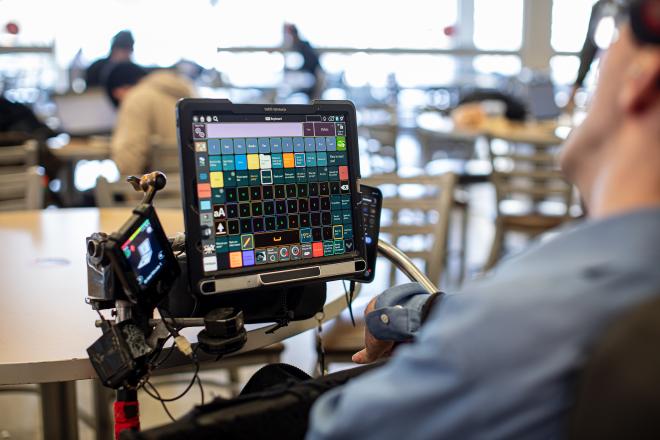
He also has cerebral palsy and hearing loss. “I use a power wheelchair and a speech device," Ben explains. "With my support workers, who are helping me with all my personal routines. My disabled body is a body which is non-traditional and my wheelchair and speech device are simply my bodily extensions.”
Today, Ben is halfway to his goal, with support from Langara’s Accessibility Services helping remove barriers along the way.
“At Langara, I can be a self-made man when it comes to resources,” Ben says.
“Don’t hesitate to ask for [academic] accommodations. It’s your education, and everything you do with it will impact your career.”
– Ben Fullerton, student
Behind stories like Ben’s is a team committed to one thing: equitable access.
Accessibility Services plays a central role in in helping students with disabilities succeed. Through academic accommodations, assistive technology, and practical support, the team helps students through their journey at Langara.
Suzanne Munson, Director of Accessibility Services, explains how her team works closely with students to create individualized academic accommodation plans designed to ensure equitable access.
“Our goal is to remove barriers in the educational setting, not lower academic standards.”
– Suzanne Munson, Director, Accessibility Services
Accessibility Services supports students across six disability categories: chronic health, physical, hearing, mental health, neurological, and visual. The College is committed to providing an accessible and inclusive academic environment for students with disabilities in line with its obligations under British Columbia’s Human Rights Code.
Support begins with a personal intake appointment. Students can book online, visit the office (B146), call 604.323.5509, or reach out by email. From there, staff work with each student to develop an academic accommodation plan that reflects their access needs and academic setting: “We take a holistic approach,” says Munson. “We look at the student’s symptoms, functional limitations, and learning environment such as course format, labs, or practical settings. Then we design a plan that meets their needs.”
Once approved, students receive an accommodation letter through a secure portal. They can decide which accommodations to activate and in which courses. “We want students to be their own advocates,” Munson adds. “They choose what to use and share the letters with their instructors.”
Faculty support is built into the process. Instructors receive clear guidance, FAQs, and access to a dedicated portal, which helps streamline exam invigilation and requests such as closed captioning.
Accommodations, determined on a case-by-case basis, are grouped into four main areas:
Support can also extend beyond the classroom. Students with financial need may receive help applying for grants through StudentAid BC. These special program grants can cover equipment such as ergonomic keyboards, amplified stethoscopes, or software licences, as well as services like tutoring, academic strategy coaching, and attendant care.
Students waiting for a formal diagnosis may also be eligible for temporary accommodations: “Sometimes students don’t know they qualify or they develop a disability after starting their program,” Munson notes. “We want them to come talk to us. Disability is a normal part of human diversity.”
According to Statistics Canada’s 2022 Canadian survey on disability, “28.6 percent of people in B.C. have at least one disability. As the population ages, this number is likely to increase.”
Each year, over 2000 students reach out to Accessibility Services, with the team supporting more than 1,300 active students, and the demand continues to grow.
“One international student came to us undiagnosed, having struggled in their home country,” Munson shares. “We helped them with a referral to get assessed and supported them through Langara. They’re now studying at UBC.”
Another student with a hearing impairment completed the Nursing program, an outcome once doubted by some in the field. “Instructors were moved to tears when that student crossed the stage,” Munson recalls. “That’s what equitable access, done right, can make possible.”
Ben Fullerton is currently halfway through his general studies at Langara, after which he plans to transfer and earn a bachelor’s degree in social work. He says Accessibility Services is helping him get there.
For prospective students wondering if they might qualify for support, Munson offers simple advice: “You don’t have to decide right away. Just book an intake appointment. We’ll walk you through the process. You can always choose later whether to use academic accommodations.”
Need academic accommodations? Learn more about how Langara’s Accessibility Services help students with disabilities access the tools and services they need confidence to succeed.